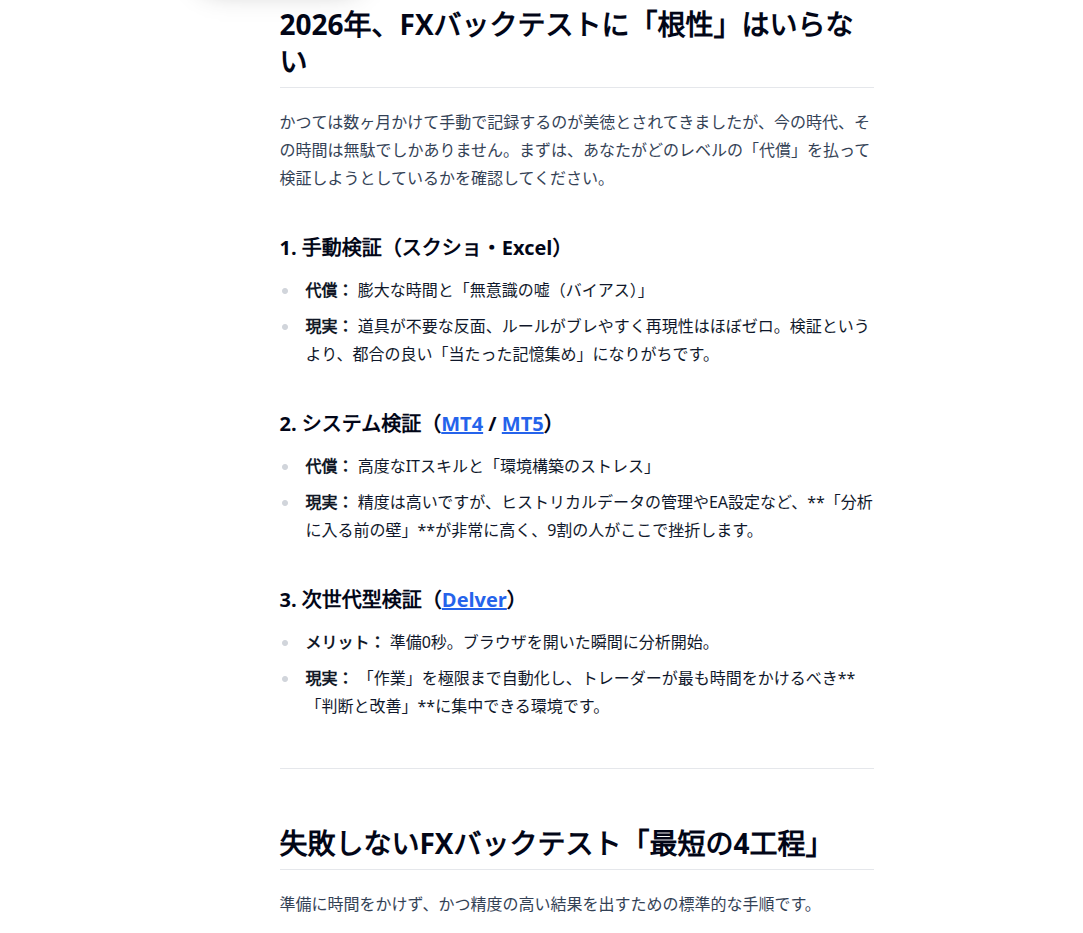
Why Is Choosing an FX Verification Tool So Confusing?
When practicing discretionary FX, many people hit the same wall:
- They don't understand the reason they are losing.
- Despite verifying, their results remain inconsistent.
- They use tools but can't judge if their verification is correct.
It is easy to think the problem lies with indicators or methods, but the most common cause is actually the verification environment itself.
The tool you choose changes the "quality of verification" entirely.
In this article, we compare free FX verification tools with a singular focus: achieving reproducibility in discretionary trading.
Conclusion: Popularity and Feature Count Are Not What Matters
When choosing a verification tool, people often prioritize these points:
- Large variety of indicators
- Rich, polished visuals
- High popularity and large user base
However, in discretionary FX verification, these are not the essence.
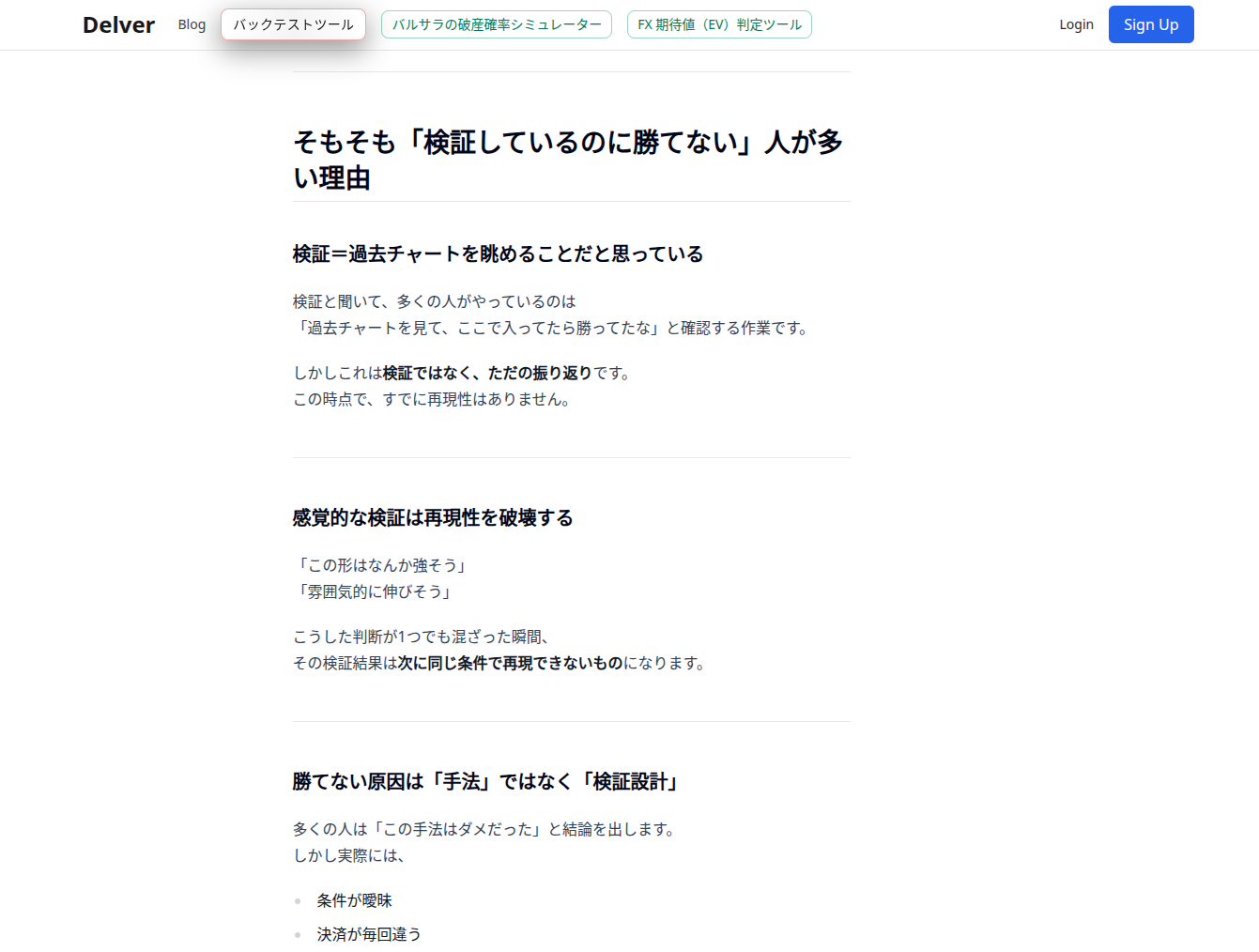
What truly matters is whether you can reproduce the exact same conditions over and over again.
Verification results that cannot be reproduced are either a fluke or numbers that only worked in the past.
Prerequisite: Minimum Conditions for Reproducibility in Discretionary FX
If you are verifying discretionary trades, you must meet at least these conditions:
- Entry conditions can be fixed without ambiguity.
- Exit conditions (TP, SL, Time, etc.) can be clearly specified.
- You can re-verify the same conditions multiple times.
- Results show numerical data beyond win rate, such as R-multiples and Drawdowns.
- You can compare differences when conditions are changed.
In this article, we evaluate each tool based on these 5 criteria.
Target FX Verification Tools (All Free)
We compare the environments most commonly used by discretionary traders:
- TradingView (Strategy Tester)
- MT4 / MT5 (Strategy Tester)
- Other free backtesting tools
- Delver
We evaluate these not based on ease of use or personal preference, but solely from the perspective of reproducibility.
Comparison Axis | Key Points Evaluated
| Perspective | What is Checked |
|---|---|
| Fixed Conditions | Can you verify with the exact same rules every time? |
| Discretionary Support | Can you input discretionary judgments as fixed rules? |
| Verification Efficiency | Are condition changes and re-verification realistic? |
| Result Visualization | Can metrics other than win rate be confirmed? |
| Reproducibility | Can others or different periods yield the same verification? |
Tool Evaluations
TradingView
What it can do
- Intuitive confirmation on the chart.
- Convenient for verifying automated trading logic.
Pitfalls in Discretionary Verification
- Difficult to strictly fix discretionary judgments.
- Comparison between changed conditions is hard to perform.
Reproducibility Perspective
- Suited for automated trading.
- Conditions tend to drift in discretionary verification.
Official TradingView site: here.
MT4 / MT5
Strengths
- Same environment as actual live trading.
- Capable of verifying automated trading (EAs).
Limits
- Requires programming for discretionary verification.
- High hurdle for changing conditions and making comparisons.
Reproducibility Perspective
- Strong as an environment.
- Difficult for non-engineers to handle.
Official MT4 site: here.
Other Free Backtesting Tools
Common Characteristics
- Easy to try.
- Limited functionality.
Why They Aren't Suited for Discretionary Verification
- Conditions cannot be fully fixed.
- Result analysis is shallow.
Delver
Delver is designed specifically for verifying discretionary trading.
- Entry and exit conditions can be fixed as rules.
- You can verify the same conditions over and over.
- Check R-multiples, DD, distributions, and more—not just win rate.
The most significant difference is that the professional backtesting processes usually written in Python can be entered via screen operations without any programming.
It occupies a unique position: a professional verification engine made accessible to non-engineers.
Official Delver site: here.
Comparison Summary: Which One Meets the Conditions for Reproducibility?
When organized by the 5 conditions of reproducibility, the options for discretionary FX verification become quite narrow.
Most free tools:
- Allow chart confirmation or one-off verification.
- Are suited for automated trading backtests.
On the other hand, they have constraints such as:
- Discretionary judgments cannot be fixed as rules.
- Comparing results after changing conditions is difficult.
- Structures beyond win rate are hard to see.
Because of this, it is easy to fall into the state of "thinking you are verifying while the conditions drift every time."
To meet all 5 conditions, simple chart replays or EA testers are not enough.
- Capability to input discretionary judgments.
- Ability to run tests repeatedly with fixed conditions.
- Ability to confirm results through structures like R-multiples and DD.
Environments that allow these without programming are rare.
In that sense, Delver is positioned as a "tool designed from the start with the necessary conditions for discretionary verification as its premise."
It is not just about having many features; the decisive difference from other free tools is its singular focus on "verifying discretionary FX in a reproducible form."
Try an Environment for Verifying Under Identical Conditions
Experience how the visualization of results changes when you fix your discretionary trading conditions and verify them.
タップして詳細を確認
What You Should Do First
Regardless of which tool you use, the first steps are the same:
- Decide on one set of conditions.
- Verify multiple periods with those same conditions.
- Change the conditions slightly and compare the results.
What matters is changing the "quality" of verification, not the "quantity."
Conclusion: The Biggest Mistake in Choosing a Tool
- Choosing based solely on the number of features.
- Using a tool just because it is famous.
- Settling for results that cannot be reproduced.
In discretionary FX, the choice of tool itself determines the verification result.
Using an environment that can reproduce the same conditions is the first step toward the shortest path without detours.
Detailed instructions on how to actually execute a backtest are summarized here—please refer to them.