Introduction | Why the "Automated vs. Discretionary" Debate Never Ends
"Which is more profitable: Automated or Discretionary trading?"
This debate has been circling in the FX world for years.
- Discretionary traders argue: "I can judge the market flexibly based on current context."
- Automated traders argue: "Calculated execution without emotion ensures reproducibility."
However, most of these discussions fail because the underlying premises are never aligned.
Different rules, different markets, different periods. You can't reach a conclusion without a level playing field.
Regarding the differences in verification environments, I’ve summarized them in the following article.
"Discretionary FX" is Not a Monolith
Discretionary trading generally falls into three categories:
- Fundamental Discretionary
- Discretionary Technical Analysis
- Semi-Automated / Rule-Based Discretionary
Among these, only the latter two can be compared fairly via backtesting.
Defining "Discretionary" for This Comparison
In this article, we define discretionary trading as follows:
Discretionary Technical / Semi-Automated
- Base entry rules are defined.
- Judgments are made based on chart patterns or indicators.
- Human discretion is used to "skip" trades or fine-tune entry timing.
This represents the majority of traders who follow "discretion with internal rules."
Fundamentals are Excluded from This Comparison
Discretionary trading based on interest rates, economic indicators, or macro-interpretations is excluded here.
The reason is simple:
- Criteria cannot be easily quantified.
- It cannot be replicated under identical conditions.
- It cannot be verified via backtesting.
This isn't about which is better; it’s simply that fundamentals do not fit into the same verification framework.
Premises of the Comparison: "Identical Conditions"
For this comparison, we have aligned the following variables:
- Identical currency pair and timeframe.
- Identical entry rules.
- Identical Take Profit and Stop Loss levels.
- Identical historical price data.
The only difference:
- Discretionary: Skipping certain signals or making micro-adjustments based on "feel."
- Automated: Executing every signal mechanically.
We will examine how this single difference affects performance and reproducibility.
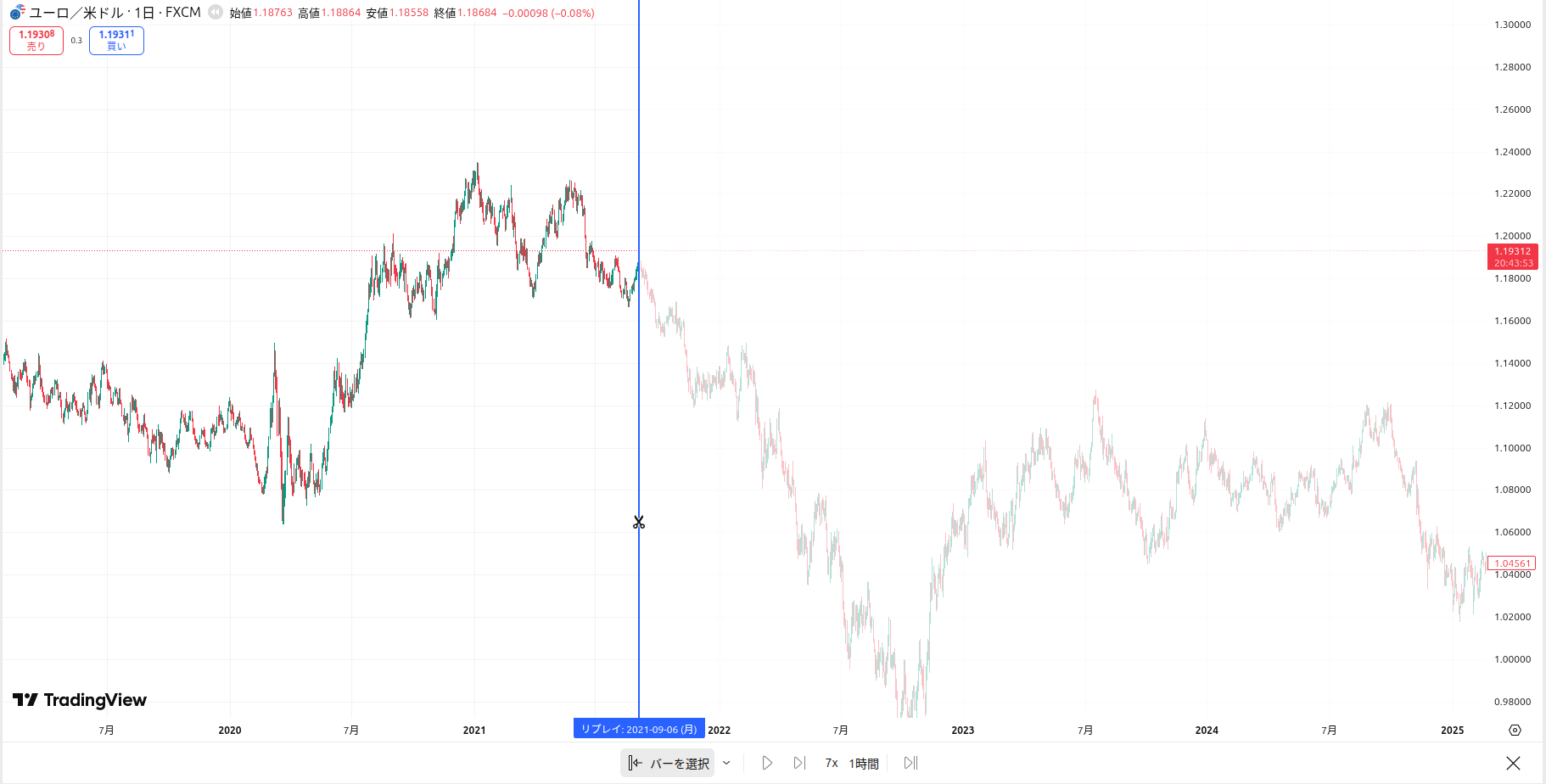
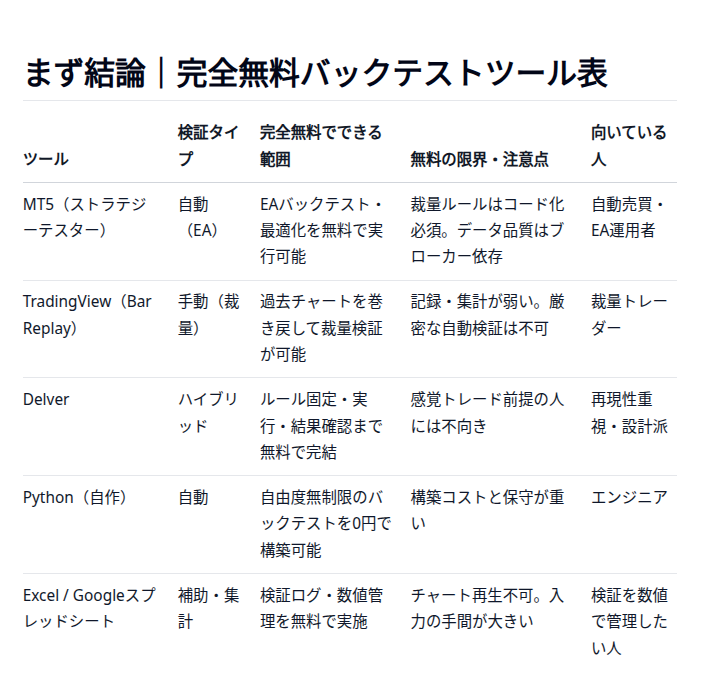
As a side note, I have compiled a list of tools that allow you to perform backtests under these conditions below.
The Conclusion
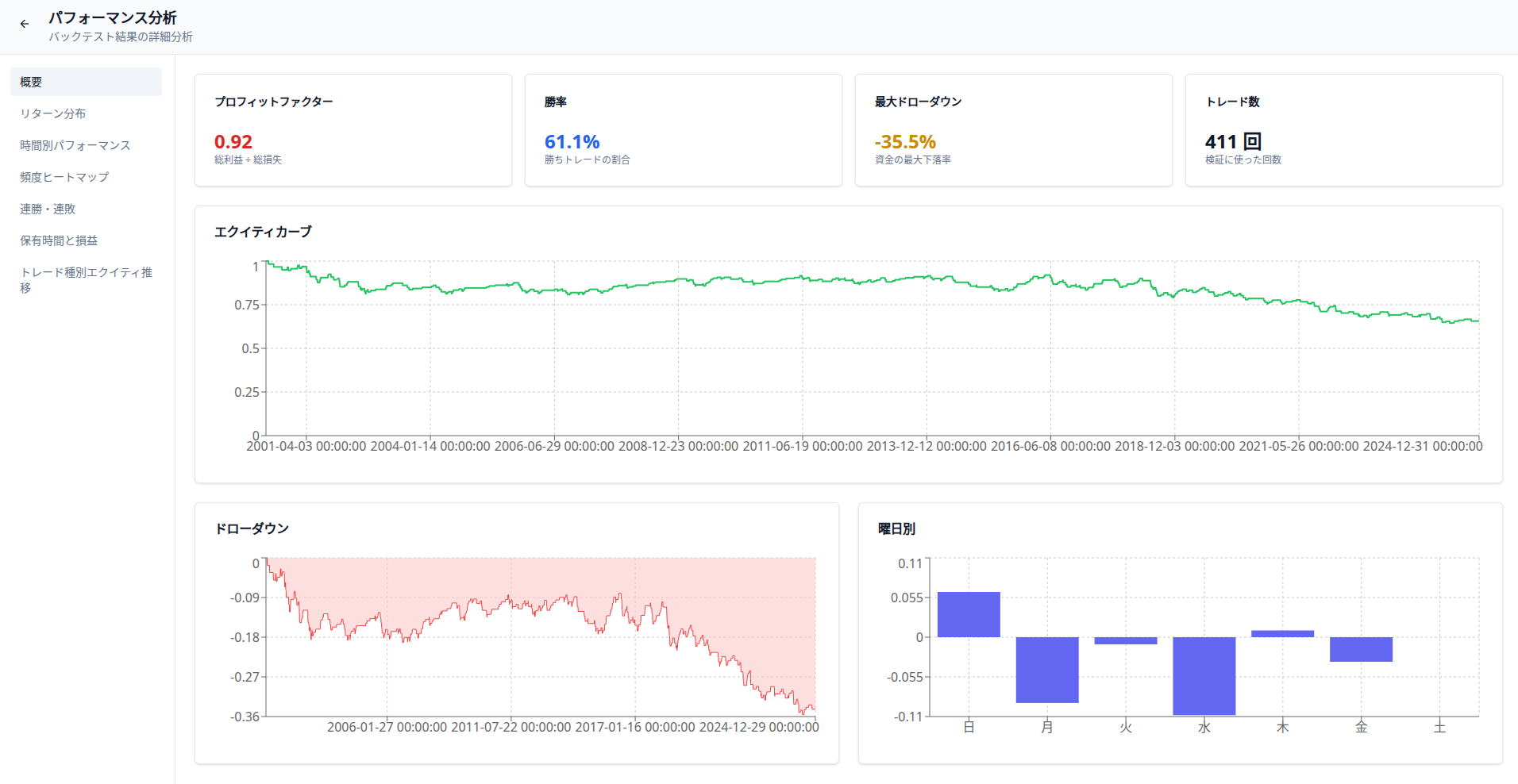
When compared under identical conditions, clear trends emerge:
- Win Rate: Discretionary sometimes appears slightly higher.
- Average R & Max DD: Automated trading is significantly more stable.
- Sample Size: As the number of trades increases, automated results converge to their true expectancy.
Let's look at why this happens.
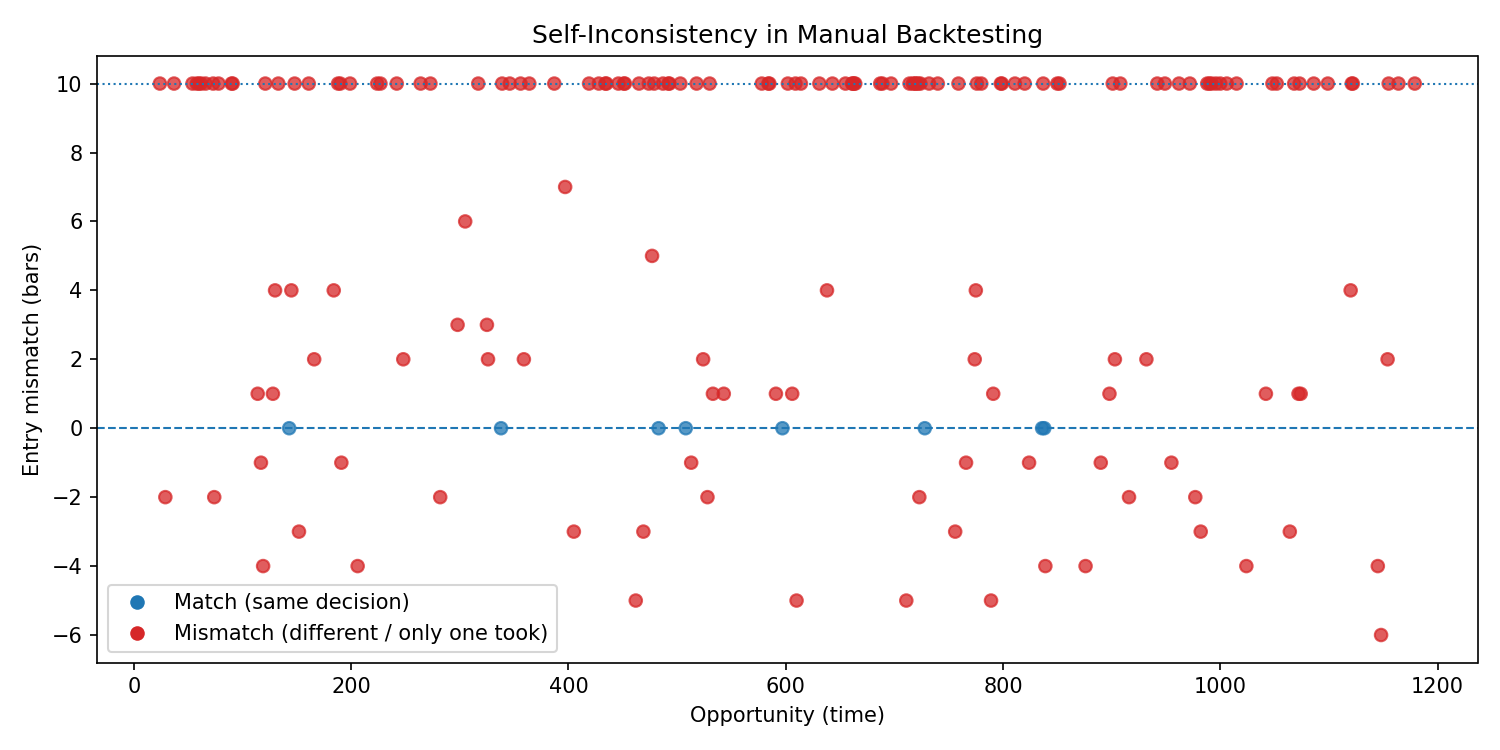
Reason 1: Discretion Hides the "Trades Not Taken"
The Blind Spot of Discretionary Trading
In discretionary trading, the following occurs daily:
- "The setup appeared, but I skipped it."
- "I don't feel like the market is right today."
- "I just lost a trade, so I’ll sit this one out."
These "decisions not to trade" are rarely recorded.
Consequently:
- Only the executed trades count toward performance.
- Skipped signals are treated as if they never existed.
Automated Trading Records Everything
In automated trading:
- The wins,
- The losses,
- And the "ugly" trades,
Are all executed and recorded equally. As a result, the true expectancy is fully exposed.
Reason 2: Differences Emerge with High Trade Volume
Discretionary Memory is Selective
Traders tend to strongly remember:
- Periods of winning streaks.
- Markets where their "feel" was spot on.
Conversely, they easily forget:
- Periods of slow capital erosion.
- Minor losses that occur over long stretches.
Automated Results Converge to the Mean
In automated trading:
- Trade count increases steadily.
- Win rate and R-multiple approach their statistical average.
- Performance becomes less volatile.
For better or worse, automated results do not lie.
Reason 3: Predictability of Maximum Drawdown (MDD)
Discretionary DD is Often "Unexpected"
In discretionary trading, the pattern is predictable:
- A drawdown occurs that is deeper than "felt."
- The trader’s mentality breaks.
- They lower their lot size or switch strategies mid-drawdown.
Automated DD Can Be Anticipated
Through backtesting, you can know in advance:
- Max Drawdown (MDD).
- Frequency of DD.
- Time to recovery.
This allows you to decide beforehand if the strategy is tolerable and if your position sizing is appropriate.
Reason 4: Detecting Environmental Changes
Discretion: "I'm Just Not Feeling It Recently"
In discretion, market shifts appear as vague, intuitive anomalies.
- "I feel like I haven't been winning lately."
- "I feel like the market has changed."
Automated: Data-Driven Anomalies
In automated trading, shifts appear as clear metrics:
- Drop in Win Rate.
- Decrease in Profit Factor (PF).
- Expansion of Max Drawdown.
This allows for verification-based decisions on whether to stop or adjust the system.
Is Discretion at a Disadvantage?
The answer is: Not necessarily.
Where Discretion Shines
- Discovering new strategy hypotheses.
- Observing market outliers.
- Exploring initial trade ideas.
Discretion is extremely powerful in the pre-verification phase.
The Problem: Stopping at Discretion
The limit of pure discretion is that it:
- Cannot be reproduced.
- Cannot be passed on.
- Cannot be systematically improved.
I’ve summarized the biases that cause these issues in this article.
Final Conclusion | The Winner is "The Verified Structure"
It is not that "automated" is inherently better than "discretionary."
The advantage lies with Reproducible Structures:
- Same rules.
- Same conditions.
- Same execution.
In fact, the most successful discretionary traders are those whose decision-making process most closely resembles an automated system.
Where does this "automated-like judgment" appear in backtest results? My next article explores how to judge trading skill beyond just the win rate.
Summary | What to Do Before You Hesitate
- Before worrying about whether to go automated or discretionary:
- Backtest both under identical conditions.
Stop judging based on feelings; judge based on numbers and structure. That is the only shortcut to surviving the markets in the long run.